
Sex Offender Checks in Jackson County
The Oregon Sex Offender Inquiry System is the official public starting point. Oregon State Police, not Jackson County, administers it. Searchers may work from a name, county, city, ZIP code, or address-based path when that control is available. County filtering is useful across Medford, Ashland, Central Point, and the smaller incorporated communities, yet city limits and mailing addresses do not always line up.
Use the result as a public-safety record, not as a complete roll of people who must report. Oregon disclosure depends on classification and statutory authority. Level 1 information is often limited, Level 2 information may receive broader disclosure, and Level 3 information receives the broadest notification. An unclassified or legacy record may need agency review. Save the date, search terms, and location used so a later check can be compared fairly.
Why Jackson Results Can Be Missing
Oregon's inquiry is not a directory of every registrant. That distinction matters more than a polished search screen. A person may have a reporting duty while their details remain outside the public view. A name can also be entered differently, and a residence near a city boundary may be indexed under another place name. No result therefore answers only one question: the public system did not return a displayed match for those inputs at that time.
Try a countywide search before narrowing by city. Then vary a full name, ZIP code, or nearby address. If the concern remains specific, contact OSP or the Jackson County Sheriff's Office rather than inferring compliance or noncompliance from silence. Never merge two people merely because their names resemble each other.
Note: Public absence is not the same as absence of a registration duty.
How to Search Oregon's Registry
Start with broad, accurate details. The registry conditions govern access, and live controls can change. The following sequence avoids both a too-narrow first pass and a same-name mistake.
- Open the official Oregon inquiry and accept its terms of use.
- Search Jackson County, or enter a full name when a known person is the focus.
- Narrow with city, ZIP, address, or radius controls that are shown live.
- Open a likely profile and compare identifiers, geography, classification, and status.
| Field | Control | Required | Use |
|---|---|---|---|
| Last / first name | Text | Optional path | Search a known name |
| County | Dropdown | Optional | Select Jackson |
| City / ZIP | Text or filter | Optional | Narrow local geography |
| Address | Text | Optional | Proximity path when enabled |
| Radius | Dropdown | Optional | Use only live choices shown |
| Search / Clear | Buttons | Not applicable | Submit or reset |
Oregon Search Versus NSOPW
Oregon's system is the better first source for Oregon classification and status. The federal National Sex Offender Public Website adds a cross-state layer. It is useful when a person recently moved, when a Jackson County address sits within a broader travel pattern, or when the state where registration began is unclear. Neither source should be treated as a substitute for police in an urgent situation.
The national portal view below illustrates that broader jurisdictional role without reproducing a private person's profile.
See the official NSOPW search source.
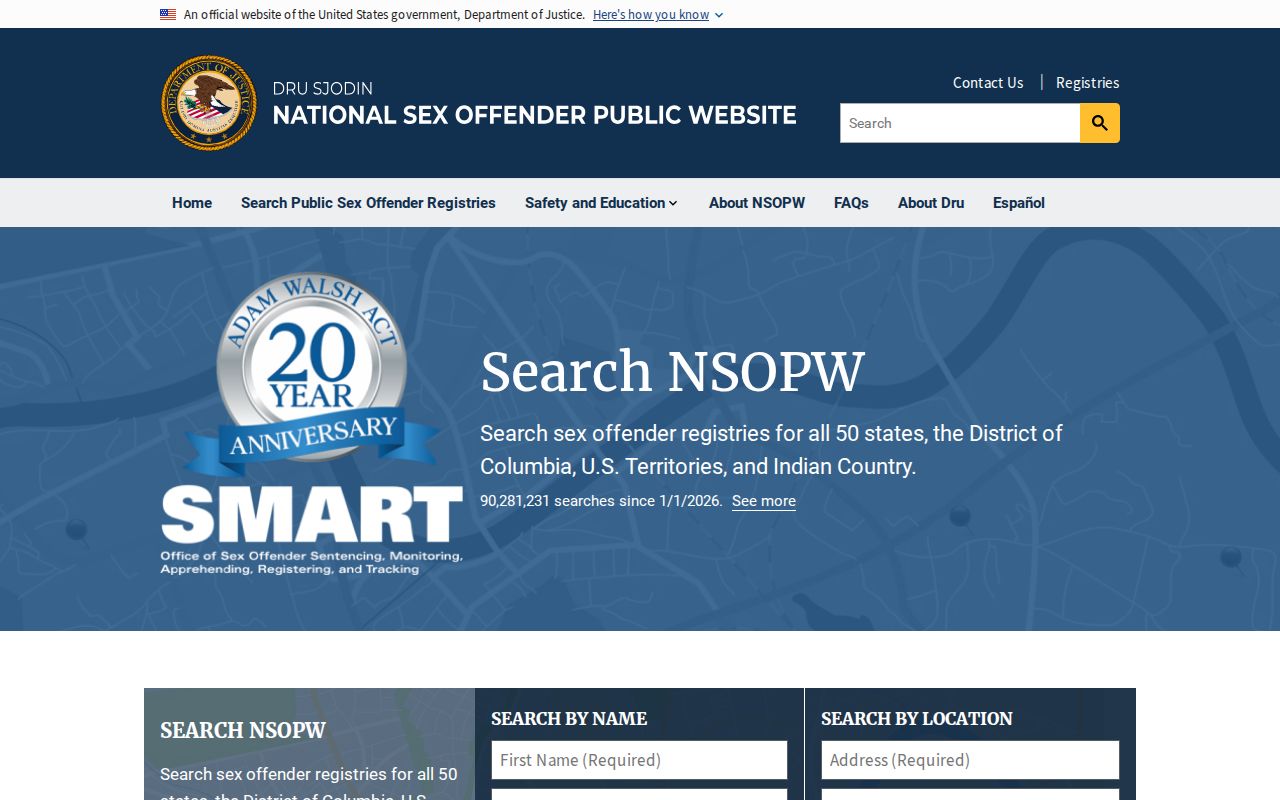
Use that national layer after Oregon's search, especially when the relevant name or address may cross a state line.
Inside a Jackson Registry Profile
A public profile may combine identity, physical, geographic, offense, and reporting information. It can show a name and aliases, photograph, authorized age or birth information, sex, race, height, weight, hair and eye color, and scars, marks, or tattoos. It may also show residence geography, jurisdiction, risk level, compliance status, and conviction or statute information. Vehicle, school, or work details appear only when disclosure is authorized.
| Name and aliases | Published identity forms used to distinguish records. |
|---|---|
| Photo and description | Image and permitted physical traits for identity review. |
| Residence geography | Address or geographic detail allowed by Oregon law. |
| Offense information | Conviction and statute details authorized for release. |
| Risk level | Oregon classification, not a federal SORNA tier. |
| Compliance status | Displayed reporting status where public disclosure permits it. |
Read each field as of the profile date. It does not establish that a person is at a location at every moment, and it does not authorize contact, surveillance, or retaliation.
Jackson Registration at Crater Lake Highway
Local registration questions go through OSP and the Jackson County Sheriff's Office. Sheriff's headquarters is at 5179 Crater Lake Highway, Central Point, OR 97502, with the main line at 541-774-6800. Confirm current registration hours before traveling because the research does not establish a permanent walk-in schedule.
The OSP offender-information page explains Oregon duties, registerable offenses, and statutory references. The official source image below helps connect a Jackson County registry question to the state rules that control it.
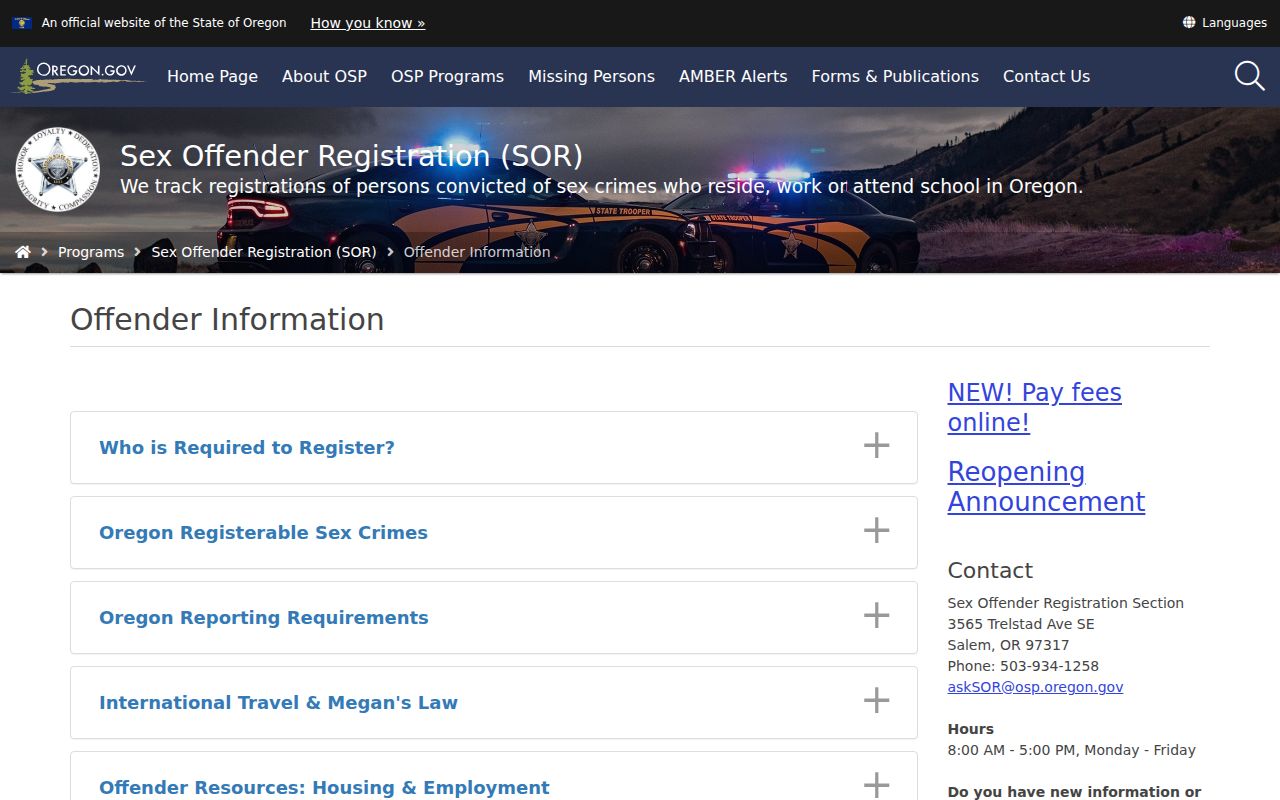
OSP supplies the statewide rule set, while JCSO is the local contact for registration issues in Jackson County.
Oregon Registration Levels and Requirements
Oregon uses risk levels, not federal tiers. The classification affects public notification, but it does not create a simple fixed public duration chart. Duties and relief depend on the governing law, the person's case, and the responsible board. Avoid converting Level 1, 2, or 3 into a federal label or assuming that a lower public profile means no duty.
| Classification | Meaning | Visibility and duration |
|---|---|---|
| Level 1 | Lower assessed risk | Limited disclosure; duty and relief depend on Oregon law |
| Level 2 | Moderate assessed risk | More disclosure as authorized; no universal federal-tier duration |
| Level 3 | High assessed risk | Broadest notification; relief or reclassification is statutory |
| Unclassified / legacy | Transition or pending status may apply | Contact OSP and do not infer a level |
Classified adults generally seek relief through the Board of Parole and Post-Prison Supervision, while the Psychiatric Security Review Board may govern applicable cases. Juvenile and victim-age paths differ.
No Universal Oregon School-Distance Rule
Oregon does not impose one blanket school or park distance rule that applies in the same way to every registrant. Supervision conditions, court orders, local facts, and a person's status can produce different limits. A map pin near a school therefore does not, by itself, prove a violation.
For a suspected breach, record the public facts and report them to JCSO or OSP. Call 911 only for immediate danger. Law enforcement can compare the report with conditions and nonpublic information that a public user cannot see.
Location tools also have ordinary limits. A street address can fall outside a chosen radius because the map centers it imperfectly, and a rural Jackson County address may use the name of a nearby community. Run both address and county searches. If the same profile returns, compare the published identifiers rather than relying on the map pin alone. When a residence field is less precise than expected, that can reflect the disclosure rules instead of missing data.
Community Notification and Lawful Use
ORS chapter 163A controls registration and public disclosure. Registry information supports awareness, family safety planning, and informed contact with public agencies. It is not an invitation to confront a registrant or household. Public access also does not prove current conduct beyond what the official profile states.
Use registry data lawfully: Harassment, threats, retaliation, intimidation, and vigilantism are unlawful misuses. Do not use public information to target a person or household.
When suspected noncompliance is not urgent, provide the exact public profile, location, date, and observed fact to law enforcement. Avoid posting accusations online. A careful report lets the responsible office verify the duty without exposing unrelated people to a same-name claim.
Community awareness works best when the record is treated as a limited official notice. Check the current profile before acting on an old screenshot or shared post. Dates, residence information, and status can change. Discuss practical safety steps with family members without publishing sensitive details or encouraging direct contact. If a profile contains an apparent factual error, route the concern to OSP, which administers the Oregon system, rather than attempting to correct it through public commentary.
Jackson County City Boundaries Matter
Medford, Ashland, and Central Point are the three largest cities, but Jackson County spans about 2,801 square miles and eleven incorporated communities. Mailing labels, city limits, county roads, and travel routes can make a narrow city search miss a relevant public result. Search Jackson County first, then use city, ZIP, or address tools to focus the review.
A county filter is also useful for checking nearby smaller communities without guessing which city label the registry uses. After that broad pass, narrow the result set. Record the precise spelling and location shown on any possible match. Those details make a call to OSP or JCSO more useful and reduce the chance that a same-name person becomes the subject of an unsupported claim.
For a current safety question, verify through the live official portal. The broader Jackson County criminal records overview explains why state, county, and city custodians may hold different pieces of one record trail.